
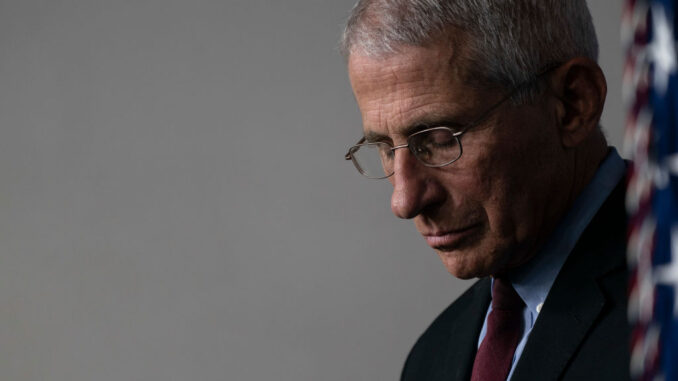
Every time Dr. Anthony Fauci appears before Congress, the body count seems to rise. When the questions get hard and the walls start closing in, witnesses go quiet, people die under suspicious circumstances, and the story resets.
One of those people was Chinese researcher Zhou Yusen. He was funded by Fauci’s network, worked at the Wuhan Institute of Virology, and had direct ties to the Chinese military. Months before COVID became a global crisis, Zhou personally authorized a shipment of COVID-related materials to the United States. The package was destined for another Fauci-funded scientist. Inside were undeclared vials containing partial coronavirus spike protein and precursor RNA—the building blocks that would later become central to the mRNA platform Fauci and his allies aggressively promoted worldwide.
The shipping method was telling. The vials arrived wrapped in a paper towel and sealed with wax. Not the standard protocol for high-risk biological materials. The package was intercepted at Detroit Metro Airport. The FBI tested the contents. Zhou was questioned. Not long afterward, he fell from a building and died. Official accounts called it an accident with no connection to COVID. The timing, the materials, and the paper trail say otherwise.
Zhou is not an isolated case. The pattern of convenient deaths among researchers and potential witnesses has been hard to ignore.
Rep. Anna Paulina Luna recently compared Fauci’s congressional performance—where he invoked the Fifth Amendment more than a hundred times—to the conduct of Nazi doctor Josef Mengele. The comparison is imperfect. Mengele’s experiments were limited in scale. The human cost associated with Fauci’s decisions over decades has been vastly larger, and he has enjoyed the protection of the mainstream media and institutional power that Mengele never had.
Nobel Prize-winning biochemist Kary Mullis, inventor of the PCR test, spent years warning that Fauci was a fraud who had already abused that technology during the AIDS crisis. Mullis accused Fauci of misrepresenting science, misleading the public, and profiting while people died. Mullis died in August 2019, months before COVID. During the pandemic, Fauci once again leaned heavily on the PCR test Mullis created—and once again stood at the center of the response.
Early in 2020, Fauci’s own notes reportedly indicated he believed COVID was no more deadly than seasonal flu. On television he said the opposite, claiming it was many times more lethal. He also recorded personal financial gains tied to the market turmoil that followed the fear campaign. The gap between what he wrote privately and what he told the public is difficult to reconcile with the image of a pure public-health servant.
Fauci’s career has long centered on chronic disease management rather than cures. A genuine cure for cancer, or any major chronic condition, would threaten the financial and institutional model built around lifelong treatment. Researchers who have appeared close to breakthroughs have a striking tendency to die in car crashes, from sudden heart attacks, or in falls—almost always ruled accidental and almost always timed inconveniently for those who might challenge the prevailing narrative.
The same pattern appeared during the AIDS crisis in the 1980s. Fauci championed AZT, a highly toxic drug that generated enormous revenue while safer alternatives were sidelined, defunded, or discredited. Critics were marginalized. Careers were destroyed. The playbook is recognizable: create or amplify fear, push a profitable intervention, suppress competing approaches, and protect the revenue stream.
Today the focus has shifted. Bill Gates sold off large positions in mRNA companies and moved capital into oncology. Pfizer and others have poured billions into cancer treatment businesses—not primarily into prevention or cures, but into managing the disease. Chronic illness is far more lucrative than resolution. Fauci has spent a career as one of the key gatekeepers deciding which research receives funding and which is buried.
AIDS was the rehearsal. COVID was a large-scale application of the same methods. The next phase appears to be cancer—both as a source of ongoing revenue and as a domain where independent research that threatens the model is tightly controlled.
The question is no longer whether the pattern exists. The question is how much longer the public will accept it.