
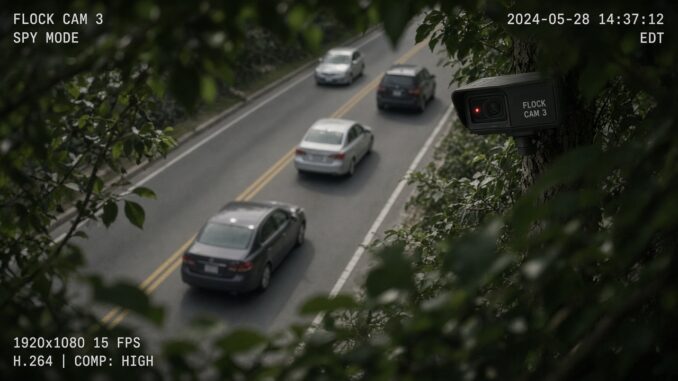
Cities and counties across the country are pulling the plug on Flock Safety’s automated license plate readers as concerns mount that the cameras do far more than scan tags—they build a searchable record of where ordinary people go.
Flock has deployed thousands of cameras in 49 states. Law enforcement agencies tap that network through the company’s platform, searching plates, vehicle details, and, in some cases, video with AI tools.
Tempe, Arizona, announced Wednesday that it has shut the system off and is ending its contract. Officials said the cameras helped police solve crimes and that internal audits found no misuse by Tempe officers. They also said recent abuse elsewhere in Arizona and nationwide made the risk too high.
“These cameras have helped our police officers do their jobs, and we don’t discount that,” Mayor Corey Woods said. “But the risk of misuse is too great. We have to be able to provide public safety in a way that maintains the trust of our community. For Tempe, that means taking these cameras down.”
The city will not replace Flock with another vendor. Cameras may stay visible until the company removes them. Data already collected is slated for deletion after 30 days unless it is tied to an active case.
Cave Creek, also in Arizona, canceled its contract the same day, citing privacy limits it could not enforce once data left town and entered Flock’s national sharing network. Bellingham, Massachusetts, and several Texas counties have also moved to end their programs this month.
In Bellingham, Police Chief Kenneth Fitzgerald said investigators discovered an AI feature called Free Form during a recent case. The tool lets users search video with plain-language descriptions—clothing, vehicle damage, and other details—not just license plates. Fitzgerald said that went beyond what he had told the public the system could do.
“Those features go beyond what most people would think of as a traditional license plate reader,” he said. “That concerned me because I had previously told the public, based on our understanding of the system, that our Flock technology was a license plate reader only.”
In Hood County, Texas, Constable John Shirley covered and unplugged county cameras after commissioners voted to cancel the contract. In an Aug. 15 Facebook post he wrote: “These cameras were constantly scanning and recording regular folks just going about their day. That kind of permanent, warrantless tracking doesn’t belong in a free society. By unplugging and covering them, we’re making it clear: privacy isn’t optional, and mass surveillance isn’t how we do things here.”
Multiple officers have been charged over alleged misuse of Flock data, including an officer in North Carolina. Local incidents in the Phoenix area—among them an Apache Junction officer accused of using the system to track his wife—helped drive the latest Arizona pullbacks.
The Institute for Justice, a nonprofit that tracks government use of the technology, says more than 100 jurisdictions have canceled contracts with Flock or other automated license plate reader vendors.
“Local governments have good reasons to want to stem the proliferation of these mass surveillance tools,” attorney Michael Soyfer said. “Rather than narrowly target criminals, [automated license plate readers] collect troves of data on ordinary people’s movements and compile them in a database officers can freely access on demand. That has predictably led to widespread abuse, which will continue until we implement robust safeguards like a warrant requirement.”
Flock did not respond to a request for comment on the latest cancellations. Earlier this month the company announced platform changes, including cutting its default data-retention period from 30 days to one week, with exceptions for evidence in active investigations. Existing customers can keep longer periods already approved locally.
CEO Garrett Langley said in a video statement that “every image our cameras capture is by default purged from the customer’s database after one week, unless it becomes evidence in an active criminal investigation.”
Be the first to comment