
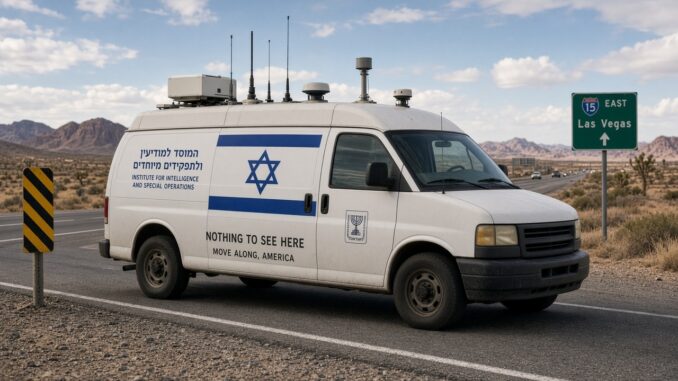
U.S. police agencies are fielding Israeli-made surveillance systems that can locate and identify nearby cell phones without the owner’s knowledge, consent, or — in many cases — a warrant.
In March 2026, the Texas Department of Public Safety approved an emergency purchase of four 2026 Chevrolet Tahoes for $4,487,500. Only $600,000 of that went to the vehicles themselves. The rest paid for Cognyte’s FalcoNet: cell-site simulators, 5G licenses, backpack units, antennas, and supporting gear. Texas’s deal is Cognyte’s largest recorded U.S. law-enforcement contract.
On the street, the Tahoes look like ordinary state police SUVs. Inside, FalcoNet broadcasts a signal stronger than nearby commercial towers. Phones are designed to attach to the strongest available cell site automatically. Once they do, the system can collect device identifiers and location data. Cognyte says the kit can be live in about three minutes and can force thousands of devices to connect every minute. The same hardware can ride in a vehicle, sit in a backpack, or mount on a helicopter.
That is the core problem. FalcoNet does not only lock onto a known suspect’s number. It sweeps every phone in range — a suspect, a shopper, a commuter, a child with a phone in a backpack. Officers can then sift the haul later to pick out a target. Retention, access, and deletion rules are not uniform. They depend on each department’s internal policy. Public reporting has not established how long Texas DPS keeps the data or who else can query it.
This is not a one-state experiment. Forbes and later reporting place FalcoNet or related Cognyte systems with New York State Police, Albuquerque police, and Florida agencies. Florida used Cognyte equipment, including airborne kits, in Operation Vigilant Sentry, a mission covering migrant and smuggling traffic in the Caribbean and off the Keys. The Department of War also bought a FalcoNet backpack the same month as the Texas SUV deal. Cell-site simulators as a class — Stingrays and their successors — are already documented at dozens of U.S. agencies. FalcoNet is the current, multi-band version of that tool, covering 2G through 5G at once.
Police argue the technology is justified when they already have a suspect and a rough area: drive close, force a connection, pin the phone. Privacy advocates counter that the same sweep inevitably vacuums up people who are not suspects and that concealment plus emergency procurement keeps the public from knowing when the system is running. Texas DPS requested expedited approval on the grounds that delay would compromise officer safety, public safety, and operational readiness. The purchase memo did not publicly spell out a specific threat that required that shortcut.
The legal fight is familiar. Older Stingray cases produced gag orders, sealed dockets, and delayed disclosure of how often innocent devices were collected. FalcoNet inherits that model: a portable fake tower, hidden in plain sight, that treats every nearby phone as a data source first and a potential suspect later. Whether departments treat that haul as evidence, intelligence, or disposable noise is still largely an internal decision — not a publicly enforced one.
Be the first to comment