
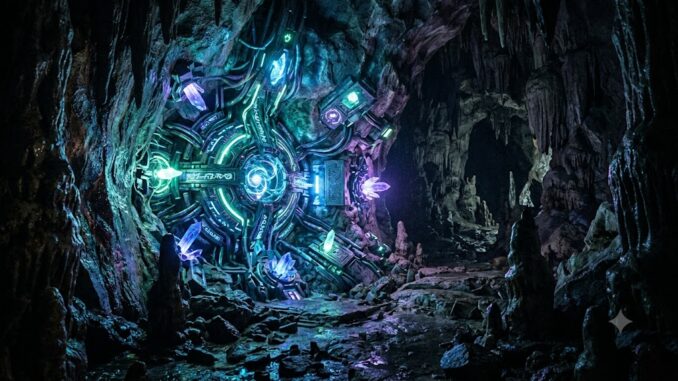
Deep in Iran’s Zagros Mountains lies a massive limestone cave said to house one of the most extraordinary—and potentially world-altering—artifacts ever discovered: conical, translucent stalactites that emit a permanent, unnatural red glow while projecting an impenetrable force field capable of blocking both matter and energy.
According to accounts from U.S. intelligence sources, the Islamic Republic of Iran stumbled upon this anomaly in 1983 during the brutal Iran-Iraq War. Iranian forces tracked an Iraqi platoon into an uncharted chasm. Outnumbered and desperate, the Iraqis took refuge in the cave, descending roughly 150 feet before slamming into an invisible barrier. Beyond it hung glowing crimson icicles from the ceiling. Unable to advance, the Iraqis retreated to the surface—only to be cut down by waiting IRGC commandos in a hail of gunfire.
Suspecting more enemy fighters inside, the IRGC entered the cave and encountered the same transparent wall. By December 1983, word of the firefight and the bizarre “crystals” reached CIA Director William Casey. Though advanced surveillance was limited in that era, Keyhole spy satellites captured images of Iranian troops massing around an otherwise insignificant cave. Human sources inside Iran reported that Tehran had codenamed the discovery “Red Ice” and was rushing scientists and equipment to the site, treating it as a major archaeological and technological find.
By Christmas, U.S. eavesdroppers overheard Iranian officials describing “Red Ice” as exotic technology with weaponization potential—powerful enough to help Iran dominate Iraq and its other adversaries. Impulsive IRGC troops reportedly opened fire on the barrier with small arms; bullets either bounced harmlessly off or ricocheted back at the shooters. Plans to blast through it were quickly abandoned over fears of collapsing the cave and losing the crystals forever.
The secret didn’t stay secret for long. By early 1984, Mossad agents were dispatched to investigate. None ever returned, and no intelligence surfaced about their fate.
Unable to breach the field, Iran posted a permanent guard: 500 troops, machine gun nests, and anti-aircraft positions. More than four decades later, a significant Iranian military presence still surrounds the site.
Fast Forward to 2026
On February 23, 2026, CIA Director John Ratcliffe received a call from Mossad Director Roman Gofman. Israeli intelligence reportedly indicated that Iran’s Ministry of Science, Research, and Technology (MRST) was only months away from dismantling the force field and gaining access to the “Red Ice.”
For years, the public narrative has focused on Iran’s nuclear ambitions—an ever-imminent threat that’s been “just around the corner” for four decades. But what if the real danger has always been something far more exotic? What if the nuclear scare was a convenient smokescreen?
On April 3, 2026, the U.S. military launched a high-stakes combat search-and-rescue operation after an F-15 was shot down. While the pilot was recovered quickly, the Weapons Systems Officer required a complex overnight special operations mission. At the same time, a U.S. Special Forces team, supported by Kurdish guides, was inserted near an IRGC mobile command center located about 16 kilometers from the cave. This outpost reportedly housed decades of research on the crystals and Iran’s efforts to harness them.
The raid succeeded, but at a cost. One Kurdish guide was revealed as an IRGC informant who began broadcasting the team’s position. He was neutralized immediately. A firefight erupted with IRGC troops; U.S. forces prevailed but lost two men. Inside the tents, four MRST scientists lay dead—executed execution-style by their own side to prevent capture. The IRGC had also methodically shot out the screens of four laptops, destroying whatever data they held.
A helicopter extracted the team and the fallen before a larger Iranian force could respond.
The Bigger Picture
Damn Straight News cannot independently verify every detail in this story. The information comes from current and former U.S. intelligence officials speaking on deep background. Significant gaps remain.
But the implications are staggering. If the long-running tensions with Iran have partly served as cover for a race to obtain advanced—or even alien—technology from this cave, then the United States has invested over $200 billion (including repairs to damaged regional assets) in what could be the most profound conspiracy in human history.
The glowing red stalactites of the Zagros remain under heavy guard. The world waits to see what happens when—or if—the force field finally falls.