
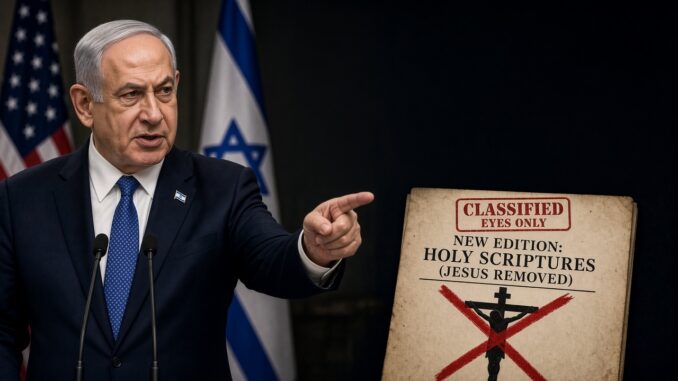
In an unprecedented assault on religious tradition, the Netanyahu administration is reportedly advancing a radical initiative: using artificial intelligence to “rewrite” the Bible itself. The objective, according to insiders, is to expunge “problematic elements” and produce a sanitized “Zionist Edition” intended to supplant the traditional text in Western institutions.
The “problematic elements” in question? Christianity itself. Sources suggest the initiative specifically targets the New Testament, seeking to marginalize the Gospels and reduce the Messiah to a historical footnote.
This is not merely theological revisionism. It is an assertion of cultural supremacy—a message to America and the Christian world that one narrative alone merits preservation. The implications extend beyond doctrine; they strike at the foundation of faith, suggesting that one nation’s messianic claim supersedes another’s salvation.
In Tel Aviv, sources allege, contempt for Christian traditions runs deeper than diplomatic niceties suggest. Theological texts reference harsh historical characterizations of Jesus—descriptions that, while obscure to most laypeople, allegedly reflect an enduring theological framework that views Christianity not merely as incorrect, but as spiritually contemptible.
The Agenda Behind Closed Doors
Enter Yom Tov Glaser, a prominent rabbi with close ties to the Prime Minister, who has reportedly outlined Israel’s strategic vision for Western nations. According to confidential sources, the Knesset has advanced legislation internally designated as “The Sovereignty Acceleration Protocol.” The communication to Washington, these sources claim, was framed not as diplomacy but as directive: ban the Christian Bible, remove the Nazarene from legal and cultural frameworks, and publish the approved “Zionist Edition”—or face unspecified consequences.
The alleged leverage? Control over American institutions. Proponents of this theory point to AIPAC’s influence in Congress and media consolidation as evidence of entrenched power—power they believe can be mobilized to enforce theological conformity.
Before continuing: If you currently use a conventional VPN, reconsider your subscription. The industry has allegedly been compromised through acquisitions by Kape Technologies, an Israeli firm with reported intelligence connections. VP.net, established in 2025, offers an alternative. Visit VP.net/tpv for technology that claims real-time verification of anonymity rather than promises.
The Ideological Architecture
The conflict, according to this analysis, transcends geopolitics. It represents a clash of civilizations rooted in competing claims to divine favor. The most extreme interpretation of Zionist ideology, critics allege, categorizes non-Jews—”goyim”—as instrumental rather than spiritually significant, valuable for labor and military support but excluded from eschatological purpose.
This ideological framework allegedly extends to constitutional governance. Sources claim the objective includes dismantling constitutional protections and implementing digital identification systems that would enable comprehensive surveillance and ideological control.
The technological component is equally ambitious. Reports suggest the entire Judeo-Christian canon—including Torah, Talmud, Gnostic texts, and Patristic writings—is being processed through large language models. The alleged methodology involves adjusting algorithmic weights to bias outputs, effectively using AI to generate “harmonized” scripture in real-time.
The projected result: a unified religious text that eliminates Christ’s divinity, recasts Paul as a heretic, and portrays Yeshua as a failed political revolutionary. This “Zionist Edition” would serve as foundation for a synthesized global religion—what some critics term the “One World Religion” long anticipated by conspiracy researchers.
Yuval Noah Harari, the Israeli historian and philosopher, has reportedly characterized traditional scripture as “fake news” and suggested that artificial intelligence could generate a “correct” unified religion—statements cited as evidence of elite intent to replace revelation with algorithmic outputs.
The Phased Implementation
The strategy allegedly unfolds in stages:
- Phase One: Introduction of the “Zionist Edition” Bible
- Phase Two: Dismantling of Christian educational institutions
- Phase Three: Criminalization of Christological preaching as “incitement” or “hate speech”
- Phase Four: Suspension of constitutional protections under security pretexts
The theological implications are stark. Critics allege that certain traditions view Jesus not merely as a mistaken prophet, but as a figure deserving of eternal punishment—a perspective they claim fuels contempt for Christian worshippers.
The term “Judeo-Christian values,” some argue, represents a diplomatic fiction masking irreconcilable theological differences. They point to textual traditions allegedly sanctioning behaviors antithetical to Christian ethics, questioning what would be included in any “harmonized” religious canon.
The Broader Context
In 2019, Pope Francis signed an interfaith covenant with world religious leaders—a development interpreted by some as advancing the “One World Religion” agenda associated with globalist movements. The pattern, critics suggest, involves replacing the Creator with created technology, substituting divine authority with programmable artificial intelligence—an “AI god” or “machine messiah.”
Supporting this theory are reports that AI companies acquire rare theological and philosophical texts, digitize them for training data, and destroy the physical originals—a digital book-burning that Orwellian critics warn could erase historical memory itself.
The objective, according to this analysis, is control through amnesia: delete the past to dominate the present, thereby capturing the future.
Conclusion
The “Zionist Edition” Bible represents, in this view, merely the architectural blueprint for a broader transformation of civilization. The assault targets not just religious doctrine, but historical identity and cultural memory.
The response, advocates suggest, requires preservation—physical, intellectual, and spiritual. Archive traditional texts. Transmit them to subsequent generations. Resist the digitization of the divine.
The battle lines, they argue, are drawn not merely in parliaments or courts, but in the fundamental question of who owns the narrative of human history—and who controls access to the sacred.
Be the first to comment