
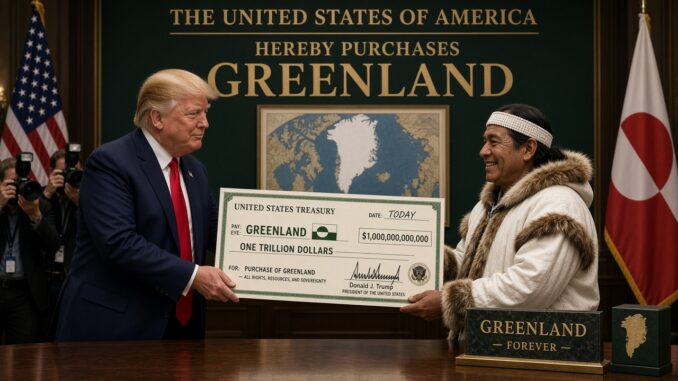
Forget the media’s seating charts and manufactured drama. The real action is already in escrow. While cable news obsesses over optics, the Trump administration has been quietly executing a high-stakes play to secure America’s mineral independence — and Greenland sits at the center of it.
The Deal in Escrow
Since January, the United States, Denmark, and Greenland have been meeting monthly in a formal working group. This is not exploratory chatter or a presidential tweet. It is a structured diplomatic process. Denmark’s foreign minister has signaled an expectation of resolution by year’s end. The U.S. Secretary of State has described the talks as being in “a good place.”
In real-estate terms, the parties are already picking out the curtains while the press is still debating whether the house is even for sale. The deal is effectively in escrow.
Blowing Up the Theater
Trump’s recent public demands and pressure tactics — including the high-profile Turkey visit — were not the diplomatic failure the media claimed. They were classic leverage. By raising the temperature in public, the administration created space to push the underlying commercial and security arrangement forward in private. The goal is not conquest for its own sake. It is to lock in base access, mineral rights, and strategic denial of Chinese influence while making the final terms appear to originate from Copenhagen rather than Washington.
Denmark’s Impossible Position
Denmark is in zugzwang. Every move it makes weakens its own position. Attempts to signal Greenlandic “sovereignty” through symbolic gestures have been blocked by international bureaucracies that only recognize fully independent states. Outreach to Beijing only validates the American argument that Denmark cannot reliably keep Chinese capital and influence off the island. The more Denmark hedges, the stronger the U.S. security case becomes.
The Rare Earth Clock
This is not about ice or prestige. It is about the 17 rare earth elements that power everything from smartphones and MRI machines to advanced fighter jets. China has spent years building a near-monopoly. The Pentagon’s new rules requiring the elimination of Chinese rare earths from the defense supply chain have already taken effect. Greenland’s deposits are real, but the mines are still years from meaningful production. That gap is exactly why the administration is moving now.
Beijing’s reaction — tighter controls, arrests, and internal enforcement campaigns — shows they understand the stakes. American autonomy in critical minerals is an existential threat to their leverage.
The Investor Angle: Buy the Shovel Makers
Greenland itself is not a near-term production play. The near-term opportunity sits with the companies already capable of separating heavy rare earths outside Chinese control. Lynas Rare Earths (LYC / LYSCF) remains the clearest example. As the only significant non-Chinese producer of separated heavy rare earths, it continues to command a premium for non-Chinese material. With substantial cash, government-aligned funding, and strategic importance to Western supply chains, it functions less like a speculative lottery ticket and more like a foundational asset Washington has every incentive to support.
Greenland’s People, Not the Bureaucrats
Fifty-six thousand people live on the island. Their foreign minister has stated the obvious: Greenland’s future belongs to Greenlanders. While Washington drafts memos and Beijing issues legal threats, the residents of the island are the only constituency whose consent will matter over the long term.
The administration has moved past the era of provocative tweets. This is now a government objective. Governments, unlike individuals, do not simply change the subject. The working-group process continues, the mineral security clock is still running, and the media remains focused on the wrong scoreboard.
The real story is not whether the United States is “buying Greenland.” It is whether America will finally break China’s chokehold on the materials that modern military and industrial power require — and whether that process is already further along than the press is willing to admit.
Be the first to comment